


The short answer
Most warming drawer problems, such as no heat, too much heat, uneven warming, or unresponsive controls, trace back to a heating element, thermostat or sensor, control board, or drawer hardware, and they're usually worth repairing on a high-end unit. A technician can test these parts in your home and tell you plainly whether a repair makes sense.
A warming drawer only matters when you need it: when dinner is ready before your guests are, or when plates need to come out warm. When it stops heating, runs too hot, or won't open smoothly, it's easy to put off. Most faults are fixable and usually come down to a handful of parts. Viking Appliance Services repairs built-in and professional-style warming drawers in Reseda and the surrounding San Fernando Valley, with a focus on Viking, Wolf, and Thermador units, including those installed in kitchens built around Sub-Zero refrigeration. We're an independent repair company, not affiliated with any appliance brand. Below is what we fix, what we check, and how a visit works.
Issues we fix
Warming drawers are simple compared to an oven, but they still fail in predictable ways. These are the symptoms homeowners call us about most:
- Drawer doesn't heat at all, even though the indicator light comes on
- Drawer gets too hot and dries out or overcooks food
- Uneven heat, with warm spots at the back and cool spots at the front
- Temperature setting doesn't match what the drawer actually holds
- Moist/crisp or humidity setting has no effect
- Touch controls or knob unresponsive, or display flashing
- Indicator or power light stays off, or stays on when the drawer is off
- Drawer sticks, won't close fully, or slides roughly on its glides
- Breaker trips or a burning smell when the drawer is switched on
What our technician checks
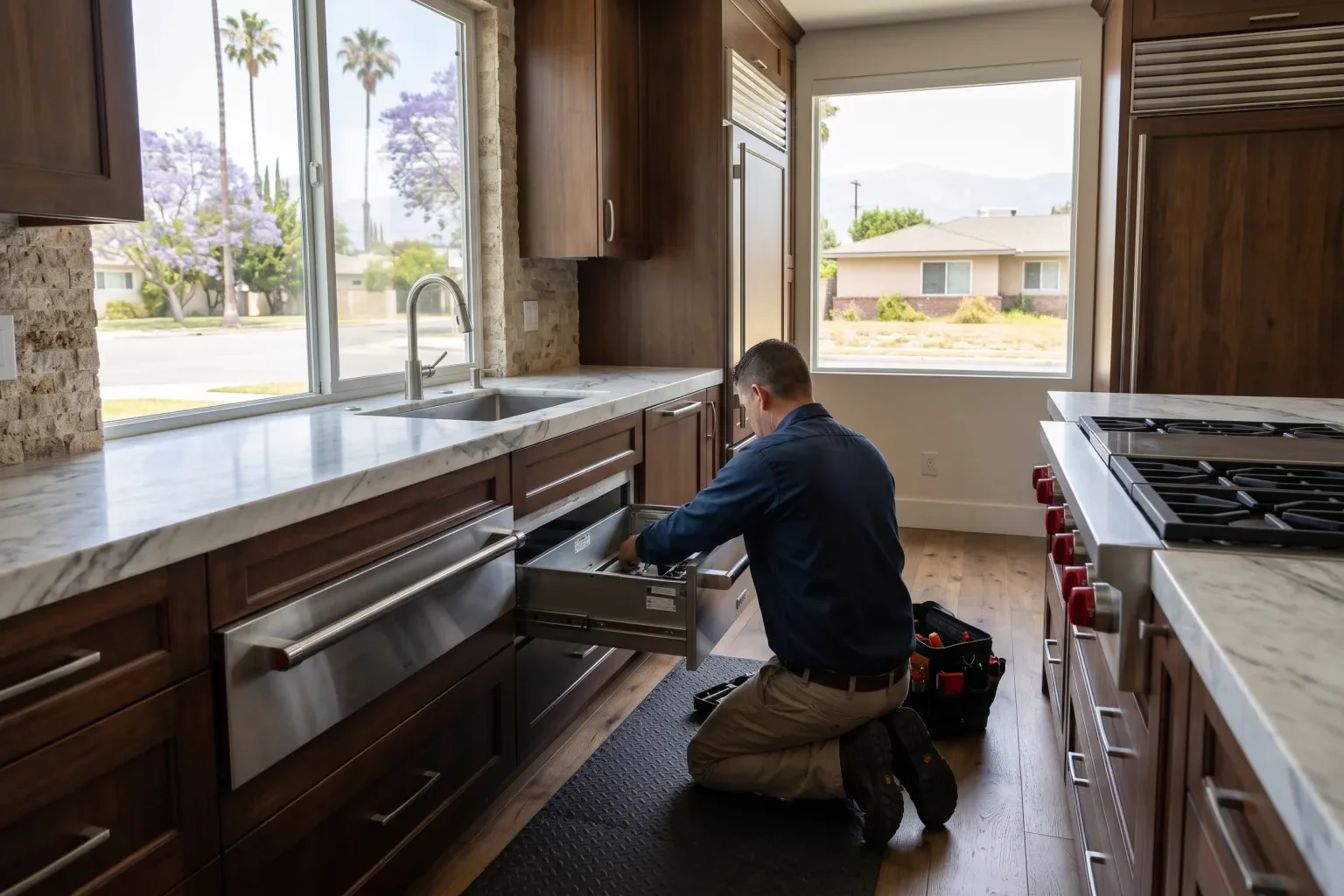
On a built-in or professional-style warming drawer, we start by confirming power at the unit and asking how the problem shows up: whether it's constant or intermittent, and at which settings. Then we work through the parts that control heat, in order.
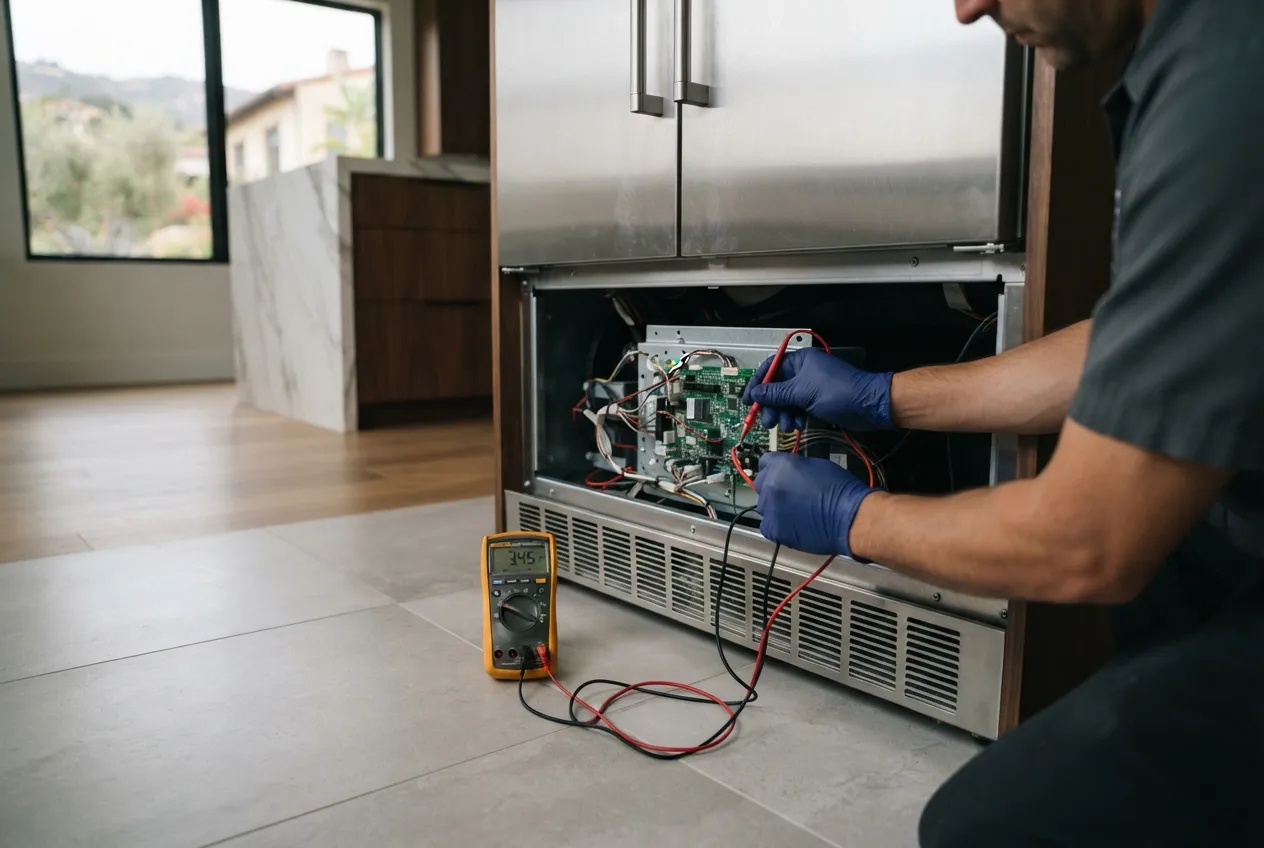
We test the heating element for continuity and resistance, because a burned-out or partially failed element is the most common cause of no heat or weak heat. We check the thermostat or temperature sensor against an independent thermometer reading, since a drifting sensor causes both overheating and underheating. On electronic models we check the control board and touch panel for failed relays, poor connections, or moisture damage. We also inspect the high-limit or thermal cutoff, which is a safety part that can open after overheating and leave the drawer dead.
Finally, we look at the mechanical side: drawer glides, the door gasket, the humidity vent, and the wiring harness behind the drawer. Wiring in a built-in drawer flexes every time the drawer opens, so worn or loose connections at the back are worth checking even if the main parts test fine.
How Viking, Wolf, Thermador and Sub-Zero kitchens differ
Viking warming drawers, especially older professional-series units, often use rotary controls with a mechanical thermostat. On these, the element and thermostat are the usual suspects, and the control knob and switch can wear with years of use. They tend to be straightforward to diagnose.
Wolf warming drawers rely more on electronic controls and settings for moist or crisp food. When a Wolf drawer misbehaves, the cause is often a sensor or control board rather than the element, and humidity settings that stop working usually point to the vent or its control. Sub-Zero doesn't make warming drawers itself, but Wolf is its sister cooking brand, so we often service Wolf drawers in kitchens built around Sub-Zero refrigerators and integrated panels.
Thermador warming drawers commonly use touch controls and are frequently paired with Thermador wall ovens. Control panel and sensor faults show up here, along with the usual element failures. Across all three brands, drawer glides and gaskets wear the same way, and custom panel installations add some care to removal.
Tell us what your appliance is doing.
Repair or replace a high-end warming drawer?
On a premium unit, repair is usually the sensible choice. The cabinet, drawer box, and glides rarely wear out, and the parts that fail, like elements, sensors, switches, and control boards, are replaceable. A warming drawer is also sized to a specific cutout and often finished with a custom panel to match your cabinetry, so replacing it can mean more than swapping one box for another.
Replacement starts to make sense when a needed part is discontinued with no workable substitute, when the drawer has heat or water damage to the housing, or when several major parts have failed at once on an older unit. If we think you're better off replacing, we'll say so and explain why, so you can decide with the full picture.
What affects the cost
We don't quote repair costs before seeing the unit, because a few variables make a real difference. The first is the fault itself: a loose connection or a failed thermal cutoff is a quicker job than tracking down an intermittent control board problem. The second is parts. Elements and thermostats are generally easier to source than electronic boards or brand-specific touch panels, and older models can take longer to find parts for.
The third is access. A drawer installed beneath a wall oven, in an island, or behind a custom cabinet panel may need extra time to remove and reinstall carefully so your cabinetry isn't scratched or misaligned. After diagnosis, we explain what we found and what the repair involves before any work goes ahead.
How a visit works
When you contact us, we'll ask for the brand, model number if you have it, and a short description of what's happening. The model and serial number are usually on a label visible when the drawer is pulled fully open. That lets the technician arrive with a better idea of likely parts.
At your home, the technician diagnoses the problem, explains the cause in plain terms, and walks you through your options. If the part is on hand, we can often finish the repair that visit. If it needs to be ordered, we'll schedule a return once it arrives. Before leaving, we run the drawer and check that it reaches and holds temperature. We serve Reseda and nearby cities across the San Fernando Valley.