


The short answer
Most ice maker failures in high-end refrigerators and undercounter units come from a short list of causes: a frozen fill tube, a failing water valve, a clogged filter, a worn ice maker module, mineral scale, or a drain problem. Because these appliances are built into cabinetry and expensive to replace, a careful diagnosis followed by a targeted repair is usually the better value.
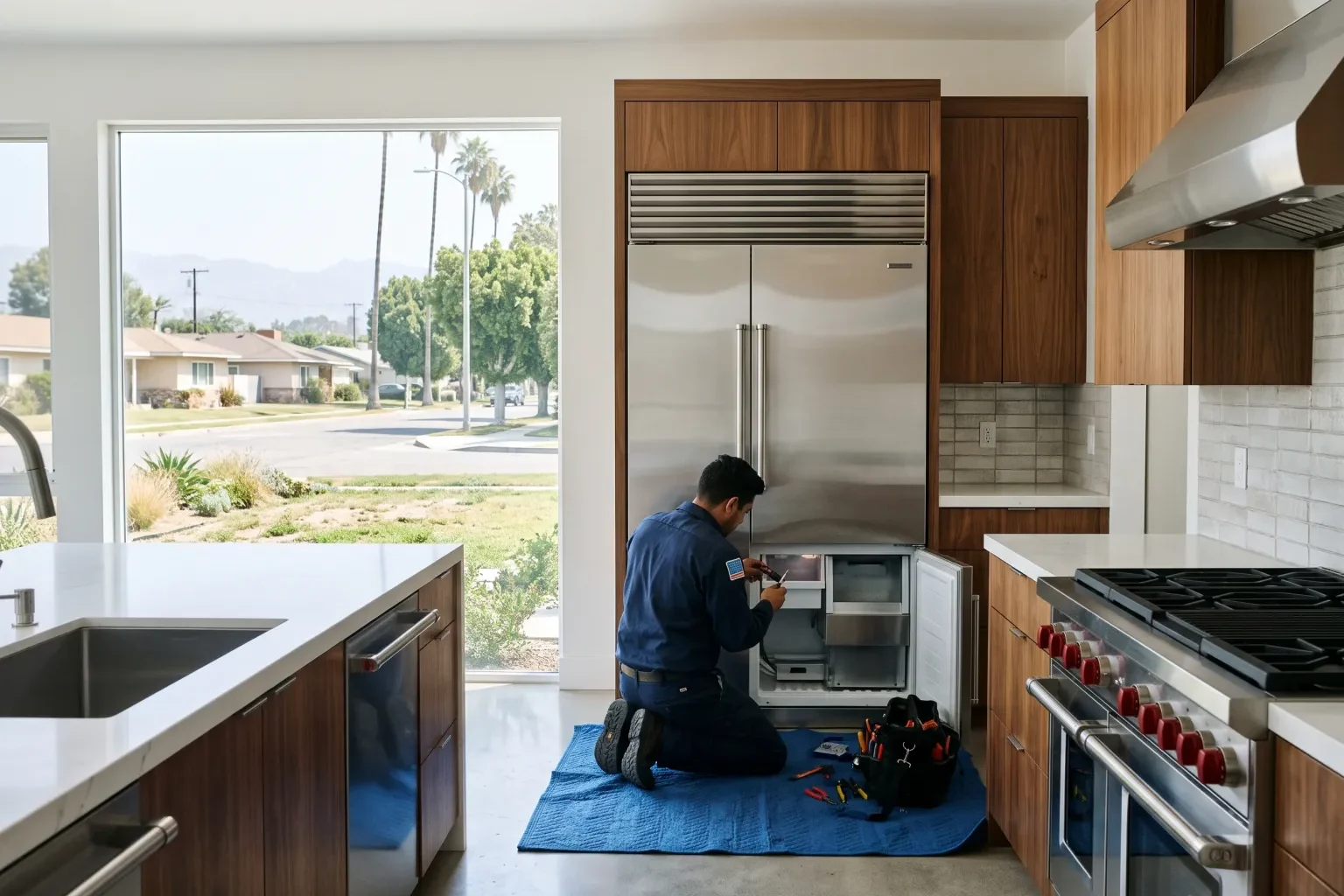
When a built-in ice maker stops producing, the problem usually shows up at the worst time: a dinner party, a hot afternoon, a weekend with guests. Viking Appliance Services repairs ice makers in premium kitchens across Reseda and the surrounding San Fernando Valley. That includes ice makers built into refrigerators and freezers, and standalone undercounter ice machines. We work on Viking, Sub-Zero and Thermador ice makers, and we regularly service kitchens built around Wolf cooking equipment, where the refrigeration is often a matching built-in. We are an independent repair company, not affiliated with any manufacturer. Our goal is to find the actual fault, explain it in plain terms, and help you decide whether a repair makes sense.
Ice Maker Issues We Fix
Ice makers tend to fail gradually, so the early signs are easy to miss. If you notice any of the following, it is worth having the unit checked before a small problem turns into a leak or a failed part.
- No ice at all, even though the refrigerator and freezer are cold
- Slow production, or small, hollow or misshapen cubes
- Ice that clumps together or freezes into a solid block in the bin
- Cloudy ice, bad-tasting ice or ice with an off odor
- Water leaking under the refrigerator or pooling inside an undercounter unit
- Undercounter ice machines that don't drain, or that overflow into the cabinet
- Frost build-up around the ice maker or a frozen fill tube
- Clicking, buzzing or humming from the ice maker with nothing coming out
- Error codes, flashing indicators or a bin that reads full when it is empty
- An ice maker that runs constantly and never shuts off
What Our Technician Checks on a Built-In Unit
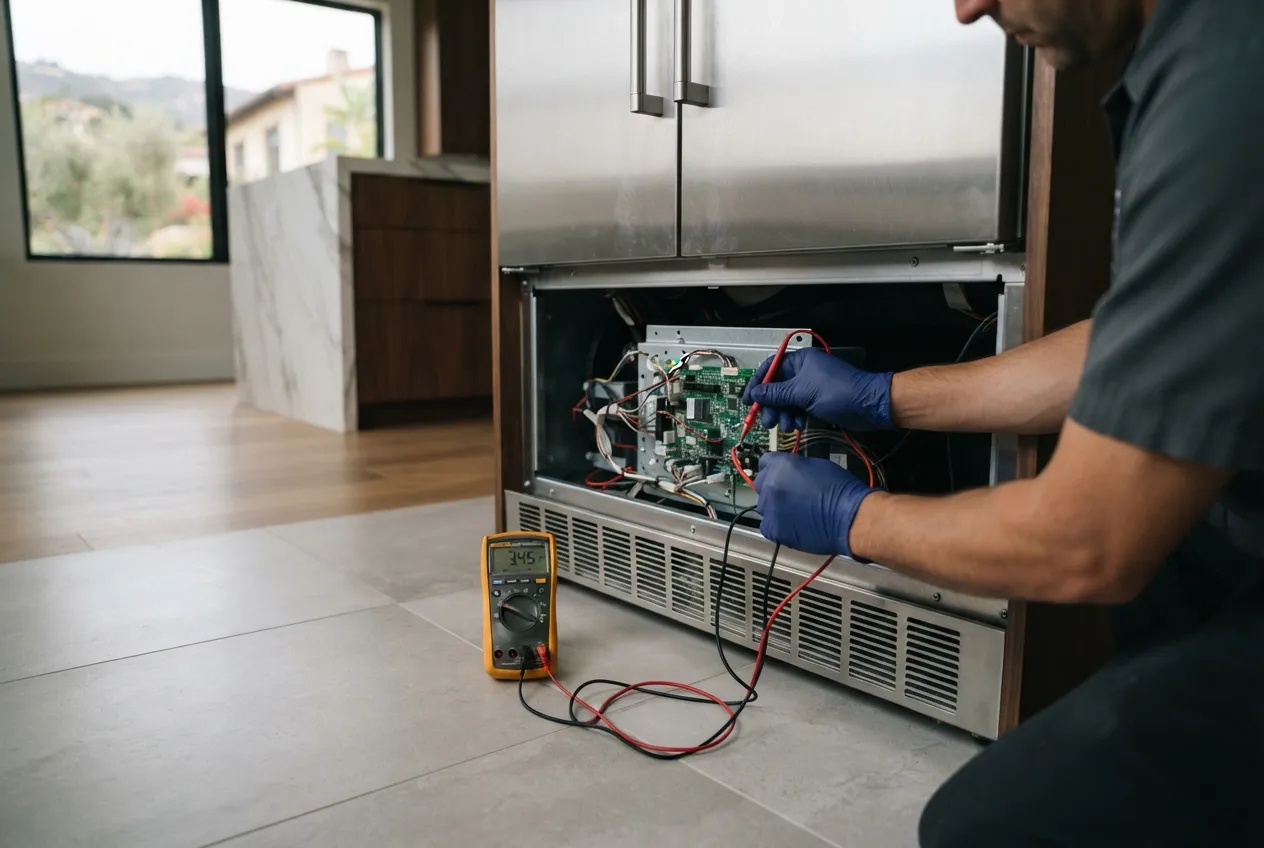
On a built-in or professional-style appliance, we start with the basics that are easy to overlook. We check the water supply line and shutoff valve, the water pressure reaching the unit, and the condition of the water filter. A clogged or overdue filter can slow fill enough to stop production on its own.
Next we look at the fill path. We check the water inlet valve for proper operation, inspect the fill tube for ice blockage, and confirm that water is reaching the mold or evaporator in the right amount. We test the ice maker module or control board, the thermistors and temperature sensors, and the bin-level sensor or arm that tells the unit when to stop.
On standalone undercounter ice machines, we also inspect the evaporator plate for mineral scale, check the water pump and distribution, and confirm the drain or drain pump is clearing water properly. Because these units sit inside custom cabinetry, we also check airflow around the condenser. A unit that can't shed heat will struggle, especially during hot Valley summers, when inland neighborhoods run much warmer than the coast.
How Viking, Sub-Zero, Wolf and Thermador Ice Makers Differ
Viking makes built-in refrigerators with ice makers as well as undercounter ice machines. On the refrigerator side, the common issues we look for are fill problems: a frozen fill tube, a weak inlet valve or a module that has stopped cycling. On undercounter models, scale on the evaporator and drain issues come up more often.
Sub-Zero builds ice makers into its full-size refrigerators and freezer columns and also offers undercounter ice units. These designs depend heavily on clean water and a current filter, so filter and supply problems are often part of the story. Sensors and control components are also on the checklist.
Wolf focuses on cooking appliances rather than ice makers. Many Wolf kitchens are paired with built-in refrigeration from the same family of products or from another premium brand, and we service the ice maker in that refrigeration as part of the same kitchen.
Thermador column refrigerators and freezers use built-in ice makers that rely on precise temperature control. When production drops, we look closely at the freezer temperature, the sensors and the water fill. A freezer running slightly warm can slow ice output without any obvious cooling complaint.
Tell us what your appliance is doing.
Repair or Replace a High-End Ice Maker?
On a premium built-in appliance, repair is usually the practical choice. The ice maker module, water valve, sensors and pumps are replaceable parts. Swapping one out is far less disruptive than removing a refrigerator or undercounter unit that was sized and trimmed to fit your cabinetry.
Replacement starts to make sense when the sealed refrigeration system has failed, when needed parts are no longer available for an older model, or when several major components are wearing out at once. In those cases we explain what we found and what each path involves, so you can make the decision with real information rather than guesswork.
What Affects the Cost of Ice Maker Repair
Every repair is quoted after diagnosis, because the cost depends on what is actually wrong. The main factors are the specific fault, the parts involved, and how hard it is to reach them.
A frozen fill tube or a clogged filter is a very different job from replacing a control board or descaling an undercounter evaporator. Parts for premium brands vary in cost and availability, and some need to be ordered. Access matters too. Units with custom panels, tight cabinetry or integrated installations can take more time to pull out safely and reinstall without damaging finishes. We explain these factors before any work begins.
How a Service Visit Works
When you contact us, we ask about the model, the symptoms and when they started. That helps us arrive prepared. At the visit, the technician inspects the unit, tests the components described above and explains the cause in plain language.
You get a clear recommendation and a quote before any repair starts. If we have the part on hand, we can often complete the repair the same visit. If a part needs to be ordered, we schedule a return trip. Before we leave, we confirm the ice maker is filling and cycling, and we share simple tips to keep it running, such as regular filter changes and periodic cleaning.