


The short answer
Most range hood problems, including weak suction, a dead or noisy blower, failed lights, and unresponsive controls, come from a specific part such as the motor, capacitor, switch, control board, or ductwork, and they can usually be repaired. On a high-end hood built into custom cabinetry, repair is often more practical than replacement.
A range hood is easy to forget until it stops pulling smoke, starts rattling, or won't turn on at all. On a professional-style range or a powerful cooktop, a working hood is what keeps grease, heat, and cooking odors from settling into your cabinets and ceiling. Viking Appliance Services repairs range hoods, wall hoods, island hoods, custom inserts, and downdraft systems for homeowners in Reseda, Northridge, Tarzana, Encino, Van Nuys, Canoga Park, and Winnetka. We focus on high-end kitchens built around Viking, Sub-Zero, Wolf, and Thermador appliances. We are an independent repair company and are not affiliated with any of these brands.
Issues we fix
Homeowners usually call us after noticing one of the problems below. Some are minor, like a clogged baffle filter. Others point to a failing motor or control. Tell us what you've noticed when you book. It helps the technician come prepared.
- Blower won't turn on at any speed
- Weak suction, or smoke and steam drifting past the hood
- Loud humming, grinding, rattling, or vibration
- Fan stuck on one speed or won't shut off
- Lights out or flickering even with new bulbs
- Touch controls or buttons that don't respond
- Heat sensor turning the fan on when it shouldn't, or not at all
- Grease dripping from the hood or filters
- Downdraft vent that won't rise or lower
- Remote or in-line blower not running while the hood's lights work
What our technician checks on a built-in or professional-style hood
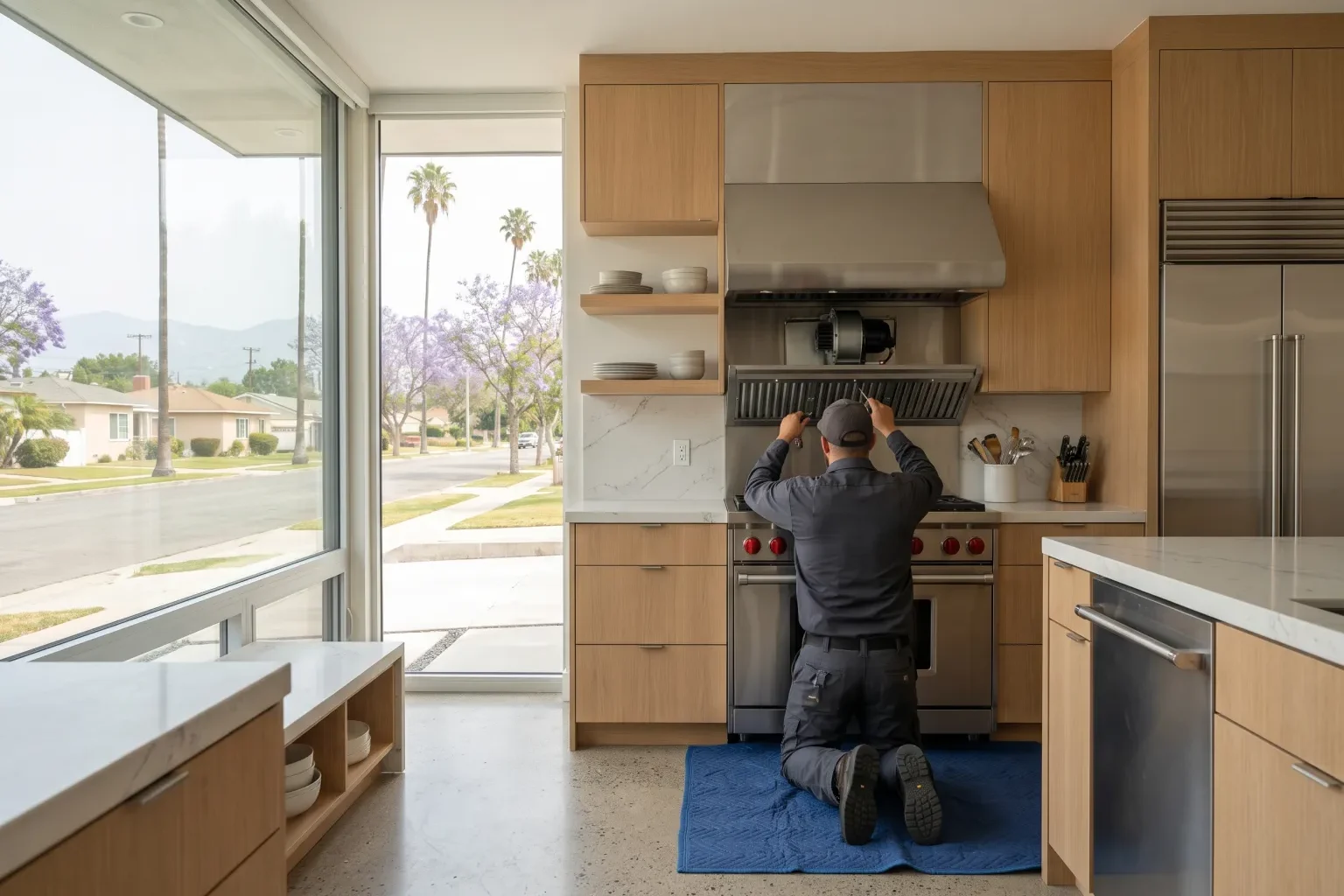
We start by confirming the symptom with you and running the hood through each speed and light setting. Then we look at airflow. Clogged baffle or mesh filters, a backdraft damper stuck closed, or a crushed or disconnected duct can make a healthy blower seem weak. On professional hoods, grease buildup inside the plenum and on the blower wheel is a common cause of both noise and poor performance.
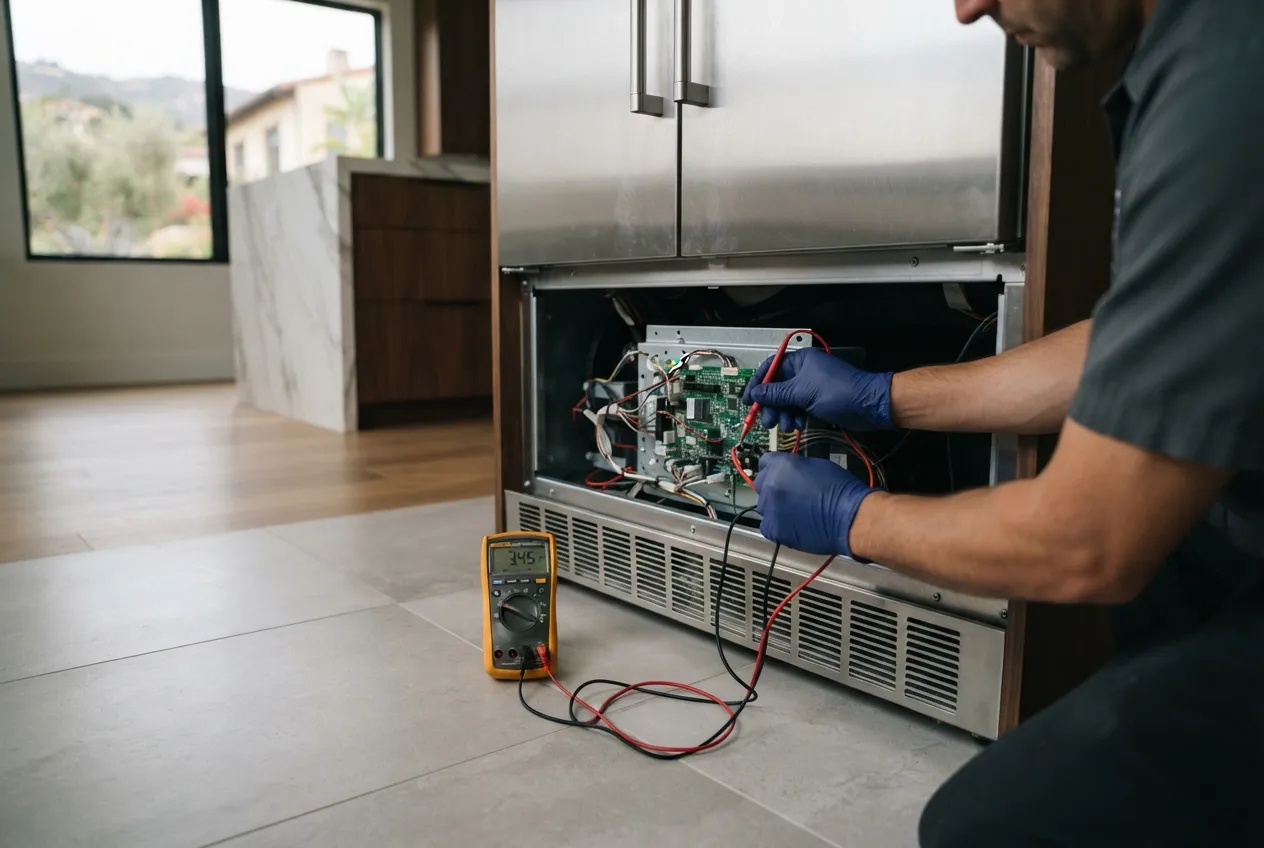
If airflow isn't the problem, we test the electrical side. That includes the motor and its run capacitor, speed switches or the electronic control board, wiring harnesses, the light circuit and transformer, and any heat sensor. Many larger installations use a remote or in-line blower mounted in the attic or on an exterior wall. In those cases we trace the connection between the hood and the blower, because a fault there can look like a dead hood. For downdraft units, we check the lift motor, gears, and travel switches. We also note anything related to make-up air controls if your kitchen has them.
How Viking, Sub-Zero, Wolf, and Thermador kitchens differ
Viking professional wall and island hoods are usually paired with high-output blowers, sometimes mounted remotely. With these hoods we pay close attention to blower motors, capacitors, and the heavy grease load that comes with a powerful gas range. Speed switches and light sockets on older units also wear with daily use.
Sub-Zero doesn't make range hoods. Its refrigerators and wine storage are often installed a few feet from the cooking area, though. When a hood isn't venting well, heat and grease spread through the kitchen and onto nearby panels and grilles. Restoring proper ventilation helps protect the rest of the kitchen, including a Sub-Zero unit.
Wolf ventilation includes pro wall hoods, cooktop hoods, and downdraft systems. Electronic controls, sensors, and the mechanical lift on downdrafts are frequent service points. Thermador offers custom inserts, chimney hoods, and downdraft ventilation. On these we often find control board or touch panel issues and blower problems in inserts tucked tightly into cabinetry. Every model is different, so we diagnose the specific unit rather than assume a fault from the brand name.
Tell us what your appliance is doing.
Repair or replace a high-end range hood?
Repair usually makes sense on a premium hood. The stainless shell, liner, and duct connections rarely wear out. The parts that do fail, like motors, switches, boards, and lights, can generally be replaced. A hood built into a custom cabinet surround or matched to a specific range is also hard to swap without carpentry and duct changes.
Replacement is worth discussing when the housing is badly damaged or corroded, when parts for an older model are no longer available, or when you're already remodeling and want a different size or airflow capacity. We'll explain what we found and lay out both paths, so you can decide with the full picture.
What affects the cost of a range hood repair
The biggest factor is the fault. Cleaning a clogged blower or replacing a light socket is a smaller job than replacing a motor or control board. Parts availability matters too. Some components are stocked widely, while others for discontinued models take longer to source.
Access also plays a role. A hood enclosed in custom cabinetry, a remote blower in an attic, or a downdraft mechanism under a cooktop takes more time to reach safely without damaging finishes. We'll explain these factors once we've diagnosed the problem, before any repair work begins.
How a service visit works
When you contact us, we'll ask for the brand, the model number if you can find it (often on a label behind the filters), and a description of the symptoms. We schedule a visit, and the technician arrives ready to diagnose the hood in place.
After testing, the technician explains the cause and the recommended repair. If the part is on hand, the repair can often be finished during the same visit. If it needs to be ordered, we schedule a return trip. Before leaving, we run the hood through every setting with you so you can confirm it's working.