


The short answer
Most cooktop problems, including burners that won't ignite, constant clicking, weak flames, uneven heat, and induction error codes, come from a specific part that can be tested and replaced without removing the unit. A technician checks ignition, gas flow or heating elements, and the control electronics on site, then gives you a clear repair-or-replace recommendation before any work begins.
A cooktop that clicks without lighting, holds a simmer one day and scorches the next, or shows an error on its glass is hard to work around. Viking Appliance Services repairs gas, electric, and induction cooktops for homeowners in Reseda and nearby communities such as Tarzana, Encino, Northridge, Van Nuys, Canoga Park, and Winnetka. We focus on premium built-in and professional-style equipment, including Viking, Wolf, and Thermador cooktops, and we work in a lot of kitchens where those sit alongside Sub-Zero refrigeration. We are an independent repair company, not affiliated with any manufacturer. Our goal on every visit is to find the actual cause, explain it plainly, and help you decide whether a repair makes sense.
Issues we fix
These are the cooktop symptoms homeowners describe most often. If you notice one of them, it helps to write down when it happens, which burner or zone is involved, and any code on the display before the visit.
Safety note: if you smell gas, don't try to light the burners or flip switches. Leave the house and contact your gas utility from outside. Call for repair once the utility has made the area safe.
- Gas burners that won't ignite, or light only after many clicks
- Igniters that keep clicking after the burner has lit, or with the knob off
- Flames that are weak, yellow, lifting off the burner, or uneven around the ring
- Burners that go out on low or won't hold a steady simmer
- Electric elements or radiant zones that don't heat or only heat partway
- Induction zones that won't recognize a pan, cut out, or show error codes
- Touch controls that are unresponsive, beep repeatedly, or lock up
- Hot surface indicators that stay on or never come on
- Uneven heat that causes scorching in one spot
- Cracked or damaged glass-ceramic surfaces
What our technician checks on a built-in or professional-style cooktop
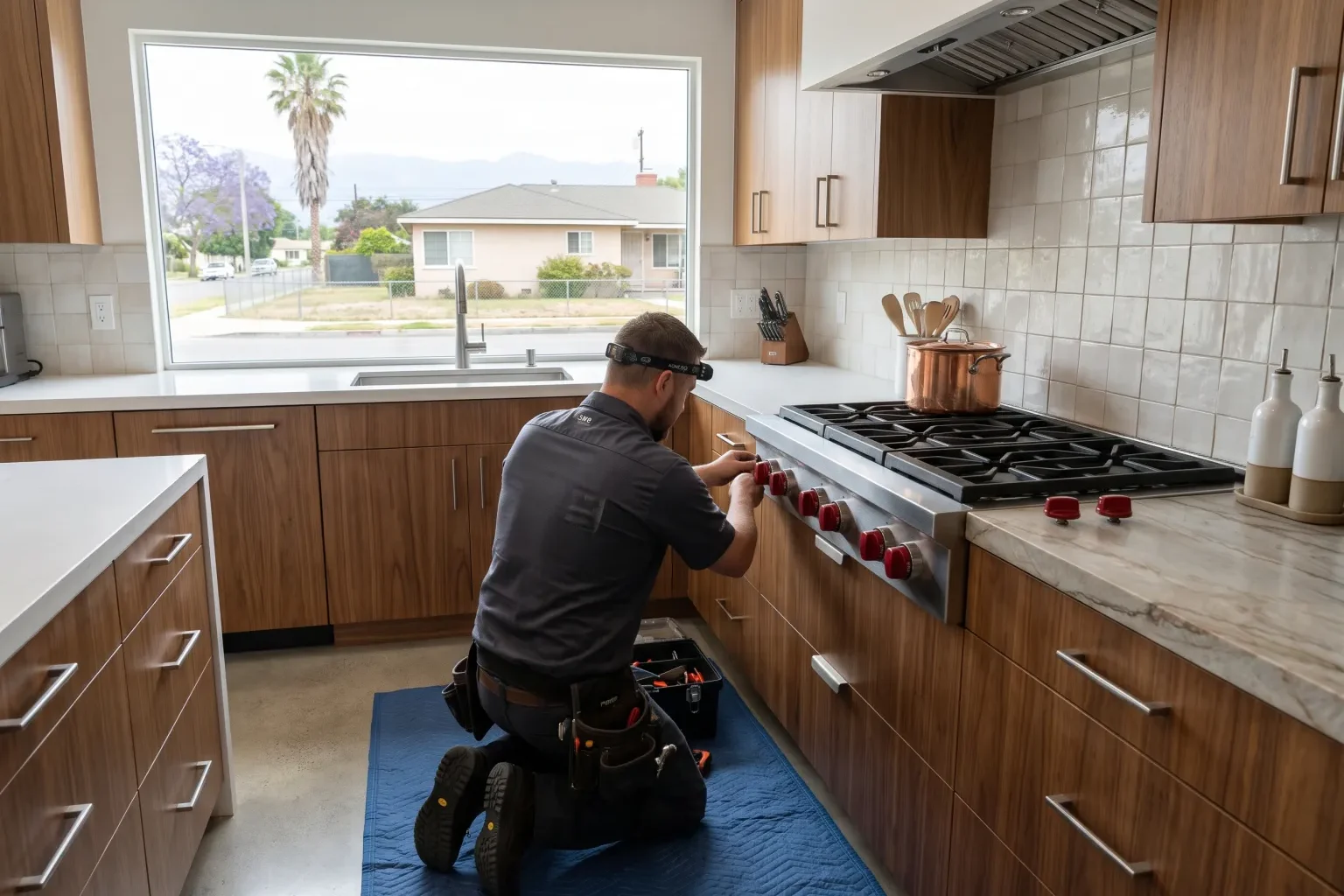
On a gas cooktop we start with the simple causes. Burner caps that sit slightly off-center, ports clogged by boil-overs, and moisture from cleaning cause many ignition and flame problems. From there we test the spark igniters, the spark module that powers them, and the switches behind each knob that tell the module when to fire. If a burner lights but won't stay lit, or the flame looks wrong, we look at the gas valves, orifices, and supply pressure, and confirm the unit is set up for the correct fuel type.
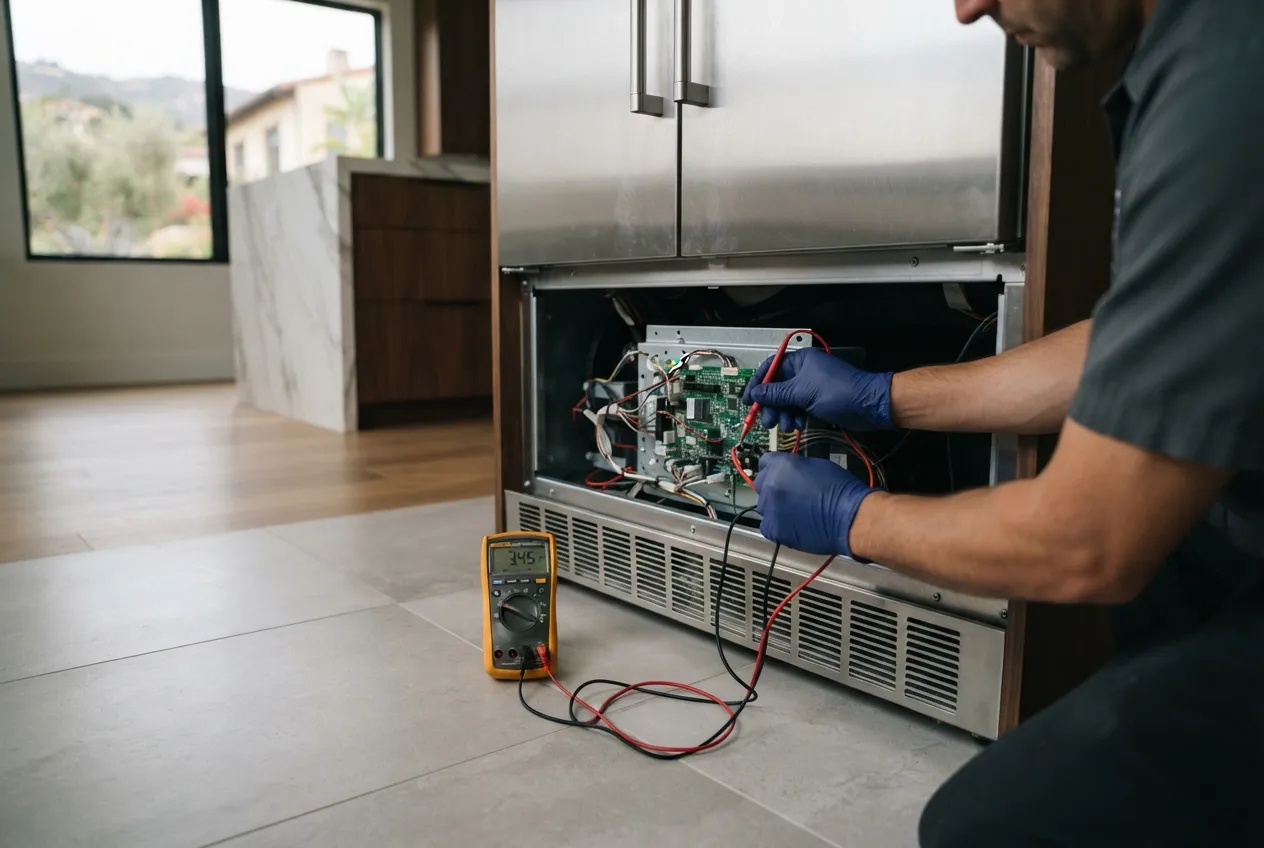
On electric and induction models the focus shifts to power and electronics. We check the incoming supply at the junction box, test heating elements and limiters for continuity, and inspect wiring that may have loosened or overheated. Induction cooktops depend on power boards, generator boards, cooling fans, and temperature sensors, so we read any stored fault codes and test those components rather than guessing from the code alone.
Built-in units also bring cabinetry into the picture. Many diagnoses can be done from the top once the grates and cooktop surface are lifted, but some need access from below through the cabinet. We check clearances and ventilation around the unit, since trapped heat can shorten the life of electronics.
How Viking, Wolf, Thermador, and Sub-Zero kitchens differ
Viking gas cooktops and rangetops use sealed burners with spark ignition, so we commonly trace complaints to igniters, spark modules, and knob switches. Because these are high-output burners, spills that bake onto burner bases and ports can affect flame quality. Viking induction models bring the usual concerns with control and power electronics.
Wolf gas cooktops use dual-stacked sealed burners designed for both high heat and very low simmer, along with automatic re-ignition. When the simmer is unstable or a burner keeps re-sparking, the cause is often in the burner assembly, the ignition system, or the valve. Wolf also makes electric and induction cooktops, where touch controls and power boards are the usual places to look.
Thermador gas cooktops are known for their star-shaped burners and a low-simmer feature that cycles the flame on and off. Owners sometimes mistake that normal cycling for a fault, so we confirm whether the behavior is by design before replacing anything. On Thermador induction units, including those with flexible cooking zones, sensors and electronic boards get most of the attention.
Sub-Zero makes refrigeration rather than cooktops, but it belongs to the same company as Wolf, and many local kitchens pair the two. If your Sub-Zero is acting up too, we can look at both appliances during the same visit.
Tell us what your appliance is doing.
Repair or replace a high-end cooktop
For most premium cooktops, repair is the practical choice. These units are built around replaceable parts like igniters, valves, elements, and control boards, and a replacement often means new cutouts, gas or electrical changes, and possible changes to countertops or cabinetry. Fixing the existing unit avoids that disruption.
Replacement deserves a serious look when the cooktop is older and parts are discontinued, when several major components are failing together, when cracked glass on a smooth-top unit is paired with failing electronics, or when you already plan to remodel or switch from gas to induction. We tell you which situation you're in and let you make the decision.
What affects the cost of cooktop repair
We don't quote prices before seeing the unit, because the cost depends on the actual problem. Cleaning and resetting a burner is very different from replacing an induction power board. After diagnosis we explain the cost before starting any repair.
- The fault itself: a cleaning or adjustment versus a tested part replacement
- Parts: availability, whether the part is model-specific, and whether more than one component has failed
- Fuel and technology: gas, radiant electric, and induction systems use different parts
- Access: custom cabinetry, tight cutouts, or a downdraft vent can add labor time
- Glass surfaces: a cracked top requires a full replacement surface
How a visit works
When you contact us, we ask for the brand, model number if you have it, whether the cooktop is gas, electric, or induction, and what you're seeing. That helps the technician arrive prepared. Before the appointment, clear the cooktop and the cabinet below if access might be needed.
On site, the technician confirms the symptom, runs tests, and explains what's wrong and what the fix involves. If the part is on hand, many repairs are finished on the same visit. If a part has to be ordered, we schedule a return trip to install it, then test every burner or zone before we leave.
Cooktop Repair by city
-
 Cooktop Repair in Hidden Hills
Local service & repairs
-
 Cooktop Repair in San Fernando
Local service & repairs
-
 Cooktop Repair in Calabasas
Local service & repairs
-
 Cooktop Repair in Beverly Hills
Local service & repairs
-
 Cooktop Repair in Burbank
Local service & repairs
-
 Cooktop Repair in West Hollywood
Local service & repairs
-
 Cooktop Repair in Simi Valley
Local service & repairs
-
 Cooktop Repair in Santa Monica
Local service & repairs
-
 Cooktop Repair in Agoura Hills
Local service & repairs
-
 Cooktop Repair in Los Angeles
Local service & repairs
-
 Cooktop Repair in Santa Clarita
Local service & repairs
-
 Cooktop Repair in Culver City
Local service & repairs